UNM-Led Study Links Climate Shifts to Extinction Events, Highlights Biosphere Vulnerability
September 23, 2026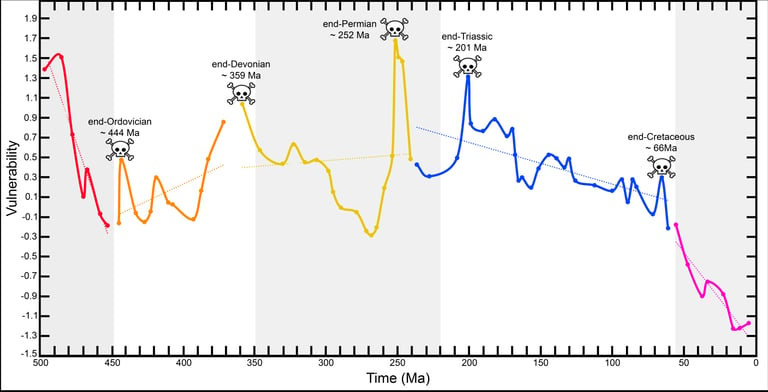

A UNM-led team combines recurrence analysis, dynamical modeling, early warning signs, and fossil/climate data to link climate regime shifts with extinction events and to quantify biosphere vulnerability—the susceptibility of biodiversity to decline when extinction outpaces new species formation.
The study demonstrates climate-state persistence and transitions over the Phanerozoic Eon, using recurrence analysis, modeling, early warning indicators, and extinction/biodiversity data.
Published in Nature Communications as “Transitions between persistent climate–carbon regimes coincide with elevated Phanerozoic biosphere vulnerability,” the work was presented by Myers at scientific meetings in 2024 and 2026, with additional presentations planned in Denver in October.
The authors stress that understanding transitions between climate states can shed light on why ecosystems become extinction-prone and highlight implications for modern climate change, including water-scarce regions like New Mexico.
Corinne (Cori) Myers, a paleobiologist at UNM, led the project, contributing data and guiding analysis and publication; the lab has built extensive climate proxy datasets over about a decade.
The international, UNM-led study analyzes 539 million years of Earth’s climate and finds that the climate tends to remain in a small set of recurring states rather than changing in a purely random manner.
The findings offer a new perspective on how climate-system transitions may influence biodiversity and stress, with relevance for interpreting past events and understanding current climate-change impacts.
Periods of elevated extinction, including the five major mass extinctions, frequently occur near transitions between climate states, indicating a link between regime shifts and biosphere vulnerability.
The study identifies five major persistent climate states, informally dubbed the “Haggis bins,” with abrupt transitions between them across the Phanerozoic Eon.
Biosphere vulnerability peaks during periods of elevated extinction and is especially high during the so-called Big Five mass extinctions.
The project originated from a two-week 2024 Futures Institute workshop at the University of Edinburgh, bringing together mathematics, climate modeling, and paleobiology researchers, and builds on Myers’ decade-long climate-proxy and extinction-rate datasets.
The Nature Communications paper, titled “Transitions between persistent climate–carbon regimes coincide with elevated Phanerozoic biosphere vulnerability,” emphasizes studying transitions to assess extinction risk.
Summary based on 2 sources
Get a daily email with more Science stories
Sources
Mirage News • Sep 23, 2026
UNM Study Links Climate Cycles to Extinction Risk
UNM UCAM Newsroom • Sep 23, 2026
UNM researcher helps uncover recurring climate regimes linked to elevated extinction risk