Black Hole Jets Disrupt Galaxy Growth by Heating and Ionizing Circumgalactic Medium
September 30, 2026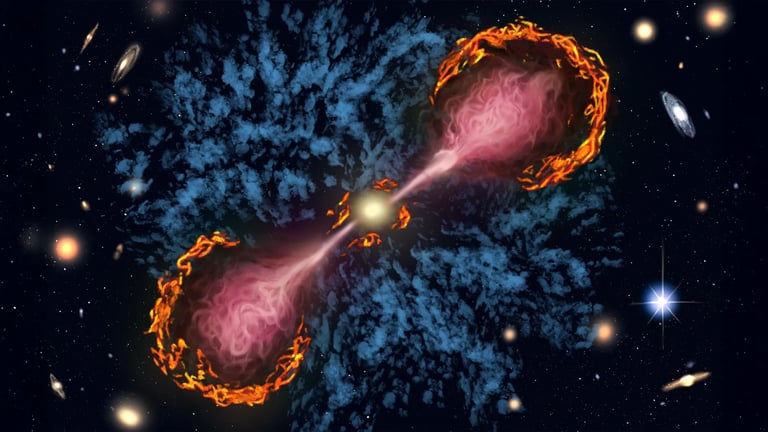

New evidence shows black hole jets regulate galaxy growth by heating, stirring, and disrupting CGM gas, limiting cold gas for star formation and pushing galaxies toward quiescence.
Despite their small size, black hole jets can influence gas hundreds of thousands of light-years away, transferring energy from the core to the outer regions of their host galaxies.
Researchers find that supermassive black holes at the centers of most galaxies help set the pace of star formation in their hosts.
This research highlight was published on October 1, 2026, with a DOI linking to the related Nature article for deeper details.
The study appears in the Astrophysical Journal Letters and is led by Sanchayeeta Borthakur of Arizona State University and Namrata Roy of the Raman Research Institute.
The Astrophysical Journal Letters is the publication venue.
Readers are invited to share favorite black hole images and feedback via email.
Jets are relativistic, form in pairs, and emit across multiple wavelengths, enabling study through X-ray, radio, and other observations.
Related pieces in Nature Portfolio touch on topics like Europe pushing for space independence amid geopolitical rifts and simulations showing overmassive black holes.
Future work includes more simulations and continued observations (DESI and LOFAR) to deepen understanding of AGN jets and CGM interactions.
The focus is on imaging the surroundings and effects of black holes (accretion discs, jets) rather than directly capturing the black holes themselves.
References include a university news post and a scholarly article on jet-aligned H-alpha emission around radio galaxies.
Summary based on 5 sources