Revolutionizing Pharma: Penn State Doctoral Candidate Enhances Sterile Filtration for Safer, Efficient Vaccines
September 30, 2026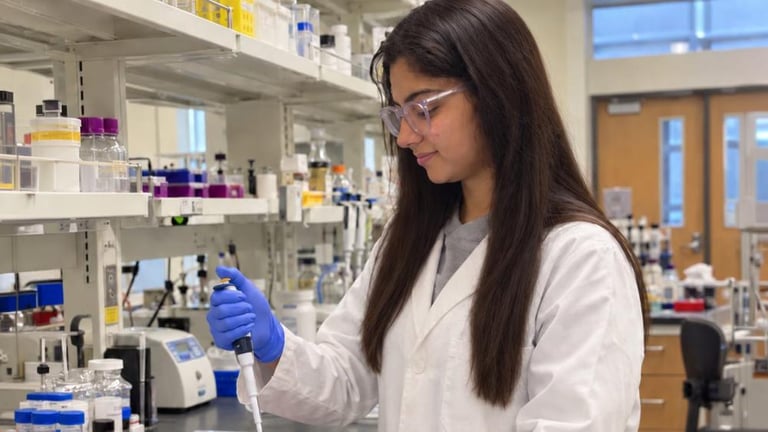

A Penn State chemical engineering doctoral candidate, Shreya Kapila, is researching how membrane surface modification can improve sterile filtration, aiming to curb contamination and boost efficiency in pharmaceutical manufacturing.
Her work addresses contamination sources—microorganisms, particulates, and impurities—and aligns with safety goals that protect patient safety and preserve product quality, including purity, potency, stability, and particle/droplet sizing.
Kapila focuses on understanding factors that govern nanoemulsion filtration through sterilizing-grade filters to enhance filtration efficiency and product yield for vaccines and other therapies.
Industry collaboration is a key feature, including a real-world Merck challenge in membrane filtration and a five-month co-op at GlaxoSmithKline to apply theory in practice.
Her experiences also include presenting at Penn State symposia and international conferences, along with teaching assistant and mentoring roles that build communication and leadership skills.
The Penn State environment enables practical industry partnerships and professional development, demonstrated by collaborations with Merck and the GlaxoSmithKline co-op.
Kapila has presented her research at university and international venues, gaining experience in teaching, mentorship, and scientific communication to help translate research into safer manufacturing.
Her work takes place in Andrew Zydney’s lab at Penn State and aims to contribute to safer, more cost-effective pharmaceutical manufacturing, especially for nanoemulsion-based vaccines and therapies.
Overall, the research seeks to translate fundamental membrane science into practical manufacturing improvements for safe, efficient production of vaccines and other therapies.
The study shows that simple surface modification strategies can significantly boost filtration efficiency and product yield without sacrificing sterility or product integrity.
Sterilization approaches vary by product; heat sterilization and gamma irradiation are traditional options, while aseptic processing and sterile filtration are essential for heat-sensitive products like certain vaccines, with trade-offs in cost and potential material damage.
Timeliness and cost of sterilization matter, as aseptic processing can be expensive due to facility and process requirements, yet remains necessary for heat-sensitive products.
Summary based on 3 sources
Get a daily email with more Science stories
Sources

Penn State News • Sep 30, 2026
Q&A: The safety and sterilization of pharmaceuticals manufacturing
Mirage News • Oct 1, 2026
Q&A: Safety and Sterilization in Drug Manufacturing
EurekAlert! • Oct 1, 2026
Q&A: The safety and sterilization of pharmaceuticals manufacturing