Ukraine Expands Unmanned Ground Vehicle Fleet to Reduce Combat Casualties by 30%
May 16, 2026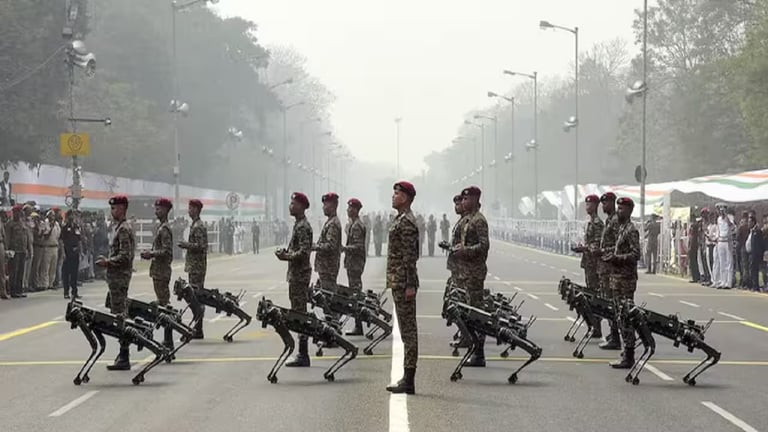


UGVs come in various sizes and locomotions—wheeled, tracked, and legged—with legged designs offering terrain adaptability but higher power use and complexity.
UGV crews form a mixed team of two drivers, two drone pilots, and one ground operator, with around a month of formal training, often conducted close to the front to speed learning and emphasize safety, route planning, and real-time decisions.
Ukraine has moved from experimental use to fielding thousands of unmanned ground vehicles (UGVs) across combat, logistics, engineering, and explosives disposal, including kamikaze roles, and this shift has helped cut casualties by as much as 30% in some cases.
The Defense Ministry plans to expand UGV fleets to about 25,000 units in 2026, focusing mainly on logistics and evacuation tasks to strengthen frontline operations.
A dedicated UGV brigade, the K-2, is being deployed to perform dangerous tasks such as mine-laying, casualty evacuation, and reconnaissance, with an explicit emphasis on saving soldiers’ lives.
Current missions cover up to roughly 48 kilometers per run, with potential ranges extending to about 145 kilometers using hybrid and conventional fuel options, and typical missions last around 10 hours.
Many UGV models use civilian components—motors, cameras, radios—enabling easier production and rapid adaptation.
The article references statements from Major Oleksandr Afanasjew of the K-2 Brigade and analysts from RUSI, along with official statements and Telegraph reporting.
Ground robot systems are remotely controlled, often track- or wheel-based, modular platforms with options such as cargo modules, robotic arms, and weapons stations.
DRDO’s Centre for Systems and Technologies for Advanced Robotics is developing humanoid robots with high mobility and AI-guided navigation to tackle high-risk missions like IEDs and CBRN threats.
Representative UGVs include Ardal, capable of mine-laying, obstacle traversal, and an optional Mk-19 grenade launcher, with other common models like Tarhan 200/300, Rys PRO, and SIM-RACAR-Lambda.
The broader trend is that unmanned systems reduce personnel risk and expand what can be done in high-threat environments.
Summary based on 4 sources
Get a daily email with more World News stories
Sources
The Times Of India • May 16, 2026
As Ukraine takes the lead in robot in combat, India deploys them on LoC
Moneycontrol • May 16, 2026
From Ukraine’s robot war to India’s LoC: How unmanned ground vehicles are changing combat