India's Ambitious V2X Initiative Aims to Revolutionize Road Safety and Mobility by 2030
June 20, 2026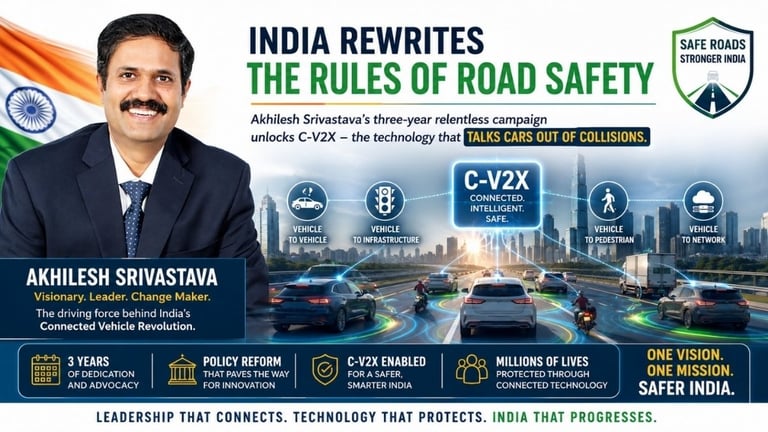

Industry leaders from SIAM, COAI, ARAI, and major OEMs welcomed the move, expressing optimism that regulatory clarity and institutional will will accelerate technology adoption.
India’s rationale emphasizes reducing human error in crashes, with MoRTH and TRAI data showing 92% of accidents are human-factor related and external estimates suggesting V2X could mitigate up to 80% of non-impaired crashes, potentially saving over 100,000 lives annually.
Akhilesh Srivastava is recognized as the driving force behind this policy shift, having built cross-sector consensus across regulators, industry players, and international standards forums over nearly three years.
De-licensing is hailed as a pivotal step toward a national connected mobility strategy, enabling rapid communications across vehicle-to-vehicle, vehicle-to-infrastructure, vehicle-to-pedestrian, and vehicle-to-network channels with sub-10 millisecond latency to reduce road fatalities.
A phased deployment plan under NAITSMIL guides progress: Phase 1 integrates C-V2X OBUs into AIS-140B vehicles and public transport, Phase 2 places Road Side Units at major highway junctions and toll plazas, and Phase 3 achieves full cooperative mobility, culminating in RoadGPT for real-time data ingestion and interventions.
The government de-licensed the 5875–5905 MHz C-V2X spectrum and the 77–81 GHz automotive radar band with immediate effect, establishing a foundational regulatory framework for India’s ITS ecosystem.
India is advancing a unified connected mobility agenda by aligning regulatory bodies (DoT, WPC, TRAI, and the Ministry of Communications) with technical standardization (3GPP C-V2X, NavIC, IEEE interoperability) and broad industry collaboration among OEMs, suppliers, and telecom operators, anchored in policy from the Supreme Court Committee on Road Safety and WEF Road Safety 2.0 commitments, with international engagement through ISO TC 204 and ITS World Congress.
A gazette notification positions India to become a leading global market for V2X, leveraging a projected market growth from under USD 1 billion in 2021 to about USD 26.2 billion by 2030, driven by its large commercial vehicle fleet and high road fatality burden.
Srivastava continues collaborating with IITs and government bodies on NAITSMIL, arguing that institutional will is the primary constraint and that technology will follow once policy clarity is achieved.
Summary based on 1 source