Nvidia Unveils Jetson Thor T3000: Revolutionizing Robotics and Edge AI with High-Performance Compute Modules
July 16, 2026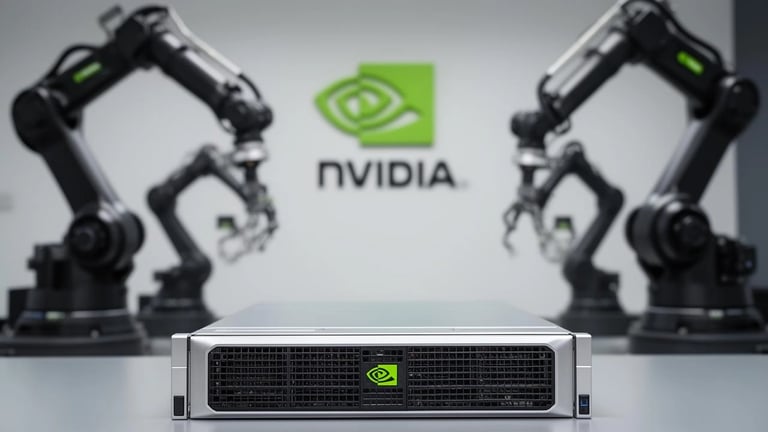

Nvidia unveils Jetson Thor T3000 and T2000 robot compute modules, powered by the Jetson AGX Thor architecture, to accelerate robotics and edge AI workloads.
The T3000 features an eight-core Arm Neoverse V3AE CPU, a 1536-core Blackwell iGPU, 32GB of memory, 273GB/s bandwidth, and delivers about 865 TFLOPS of FP4 performance, approaching the T5000's capabilities at lower GPU clock speeds.
Developers will gain access to T3000 emulation in JetPack 7.2.1 later this month, with T2000 emulation support to follow in a future release.
Nvidia’s broader market data shows data storage dominates net sales (88.3%), with gaming, professional visualization, automotive, and other segments trailing.
The shift toward smaller, cost-efficient chips reflects technological substitution driven by memory price pressures and deployment needs, pushing hardware optimization.
Huang framed Nvidia’s strategy as a five-layer cake—Chips, Infrastructure, Models, and Applications—emphasizing a full-stack, closed-loop approach with metrics like Compute equals revenue and Tokens per Watt.
The edge AI takeaway is a shift toward memory-optimal configurations enabled by software tools, aligning hardware with supplier-price realities and real-world deployment needs.
NVIDIA remains a leading designer and marketer of programmable graphics processors and related software.
Main product areas cover computing and networking solutions, including data center platforms, HPC, autonomous/industrial AI infrastructure, crypto mining processors, and embedded robotics development boards.
Nvidia collaborates with Boston Dynamics, Figure, and Unitree to accelerate deployment of advanced robotic systems across industries.
The story connects Nvidia’s AI hardware breakthroughs to crypto investors and DePIN edge networks, highlighting the appeal of high-performance, cost-efficient robotics chips for DePIN node operators.
Direct uses cited include surgical support, nursing assistance, hospital transport robots, and real-time surgical video understanding via Direava’s surgical vision language model, aiming to evolve into an intelligence layer for surgical AI.
Summary based on 14 sources
Get a daily email with more Tech stories
Sources
The Indian Express • Jul 16, 2026
Nvidia unveils Jetson Thor T3000, T2000 modules to accelerate robotics
NVIDIA Blog • Jul 15, 2026
NVIDIA Introduces New Jetson Thor Computers to Advance Mainstream Robotics and Edge AI

Crypto Briefing • Jul 15, 2026
Nvidia shrinks robotics chip size in half, maintains performance with new Jetson AGX Thor