India's PCB Industry Urges Localisation Amid Import Dependence and Supply Chain Vulnerability
August 2, 2026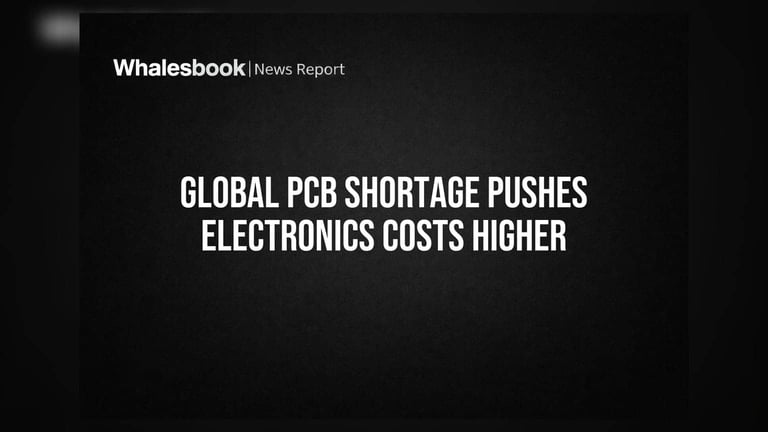

Governments and industry bodies advocate faster implementation of local PCB manufacturing under ECMS to address the supply-demand gap and restrain price increases.
ELCINA emphasizes urgent action to accelerate local PCB plants under ECMS and to ensure timely capital, equipment, and technology transfer to stabilize supply.
Iran’s strikes on facilities in Saudi Arabia are disrupting chemicals used in PCB production, with reports of a supplier responsible for a large share of a specialty chemical supply being affected.
Industry remains reliant on imported raw materials, with essential items such as photoresists largely imported and domestic processing chemicals at just 20-40% of production, underscoring the vulnerability in the supply chain.
Syrma SGS Technology cites ongoing material-cost pressures in the current and next quarters due to a PCB supply crunch.
Investors are focusing on the speed of manufacturing project execution, managing rising raw material costs without full pass-through to customers, and tracking commissioning and localisation progress to measure supply resilience.
Industry implications point to potential price hikes and continued supply constraints for electronics manufacturers and downstream users dependent on PCBs.
ELCINA urges expediting ECMS-backed Bare PCB projects (12-14 units) and ensuring timely capital input, equipment, and tech transfer to ease shortages and curb price pressures.
ELCINA warns that India’s PCB manufacturing remains highly import-dependent, with locally produced input capacity only 20-40% for key items like Copper Clad Laminate chemicals and photoresists, signaling urgent localisation and capacity expansion.
ELCINA identifies heavy import dependence on PCB inputs—CCL chemicals, photoresists, and plating/etching chemicals—and calls for rapid localisation and capacity build-out to mitigate risk.
A PCB shortage is being driven by higher material costs, supply-disruption in key shipping routes from regional conflicts, and soaring demand from AI servers, pushing prices higher across electronics.
AI-server demand is consuming PCB capacity, while power electronics and energy products are growing at roughly 30-40%, contributing to ongoing price increases in multiple markets.
Summary based on 6 sources
Get a daily email with more Tech stories
Sources

Economic Times • Aug 2, 2026
AI boom, West Asia crisis trigger printed circuit board shortage, price rise in electronics industry
Economic Times • Aug 2, 2026
AI boom, West Asia crisis trigger printed circuit board shortage, price rise in electronics industry
Business Standard • Aug 2, 2026
AI boom, West Asia crisis drive PCB shortage, raise electronics costs
Moneycontrol • Aug 2, 2026
AI boom, West Asia crisis trigger printed circuit board shortage, price rise in electronics industry