Taiwan Simulates Internet Throttling to Test Resilience Against Cyber Disruptions
August 10, 2026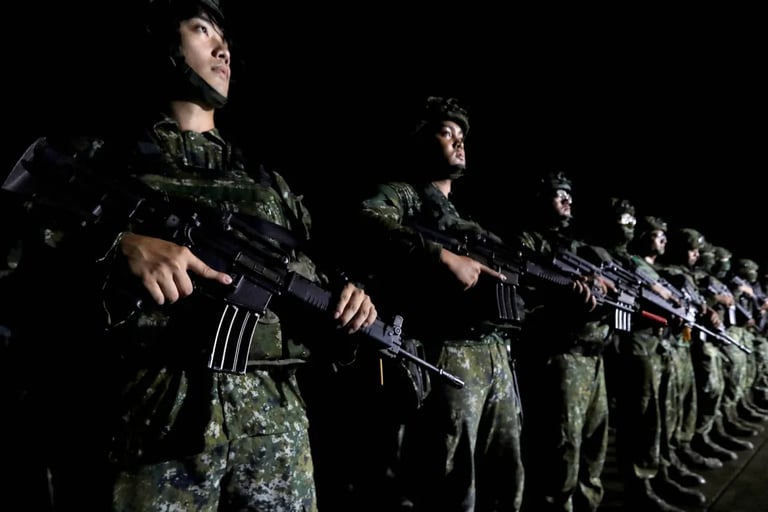


Taiwan completed the final phase of the Han Kuang drills, designed to simulate responses to a potential Chinese invasion, including a 30-minute mobile internet slowdown in Taipei and six other locales to text-only speeds of about 256 Kbps.
The exercises occur amid rising cross-strait tensions, with Chinese military activity nearby and large-scale PRC drills ongoing.
Han Kuang spans ten days and centers on repelling a Chinese air-landing assault on Penghu, while rehearsing layered coastal defense against rapid incursions.
Public briefings and advance social-media notices helped residents prepare, though reactions ranged from practical usefulness to discomfort over offline experiences in public spaces.
Experts suggest extending outage duration, testing in more regions, limiting public-space exposure, and promoting pre-downloaded offline information and alternative communication methods.
Officials say partial network degradation is more realistic than a full blackout, reflecting real-world patterns of congestion and targeted outages.
The throttle prioritized non-GBR best-effort data while preserving GBR voice services, and used the Cell Broadcast System for emergency alerts to bypass the data plane.
The drills highlight vulnerability in overreliance on constant high-speed connectivity, showing how congestion can create psychological and logistical bottlenecks even without a total shutdown.
The exercise prepares for scenarios where high-bandwidth services are unavailable due to disruptions, ensuring essential services like voice calls, ATMs, and traffic systems stay functional.
Analysts and residents noted a lack of urgency among the public, suggesting cultural or habitual complacency toward civil-defense routines.
The slowdown is framed as part of a broader effort to test resilience and readiness in telecommunications and civilian infrastructure during an attack scenario.
The legal basis lies in the Telecommunications Management Act, granting the NCC authority to direct QoS adjustments during civil-defense exercises without a state of emergency—the first large-scale use of this power.
Summary based on 20 sources
Get a daily email with more World News stories
Sources

Slashdot • Aug 10, 2026
Taiwan 'Throttles' Mobile Internet For First Time During Annual War Games - Slashdot
الشرق الأوسط • Aug 10, 2026
Taiwan ‘Throttles’ Mobile Internet for First Time During Annual War Games
Arabnews • Aug 10, 2026
Taiwan ‘throttles’ mobile Internet for first time during annual war games
StratNews Global • Aug 10, 2026
Taiwan Tests Internet Blackout During War Games