Beijing Hosts World Humanoid Robot Games, Showcasing Robotics' Rapid Progress and Industry Challenges
August 27, 2026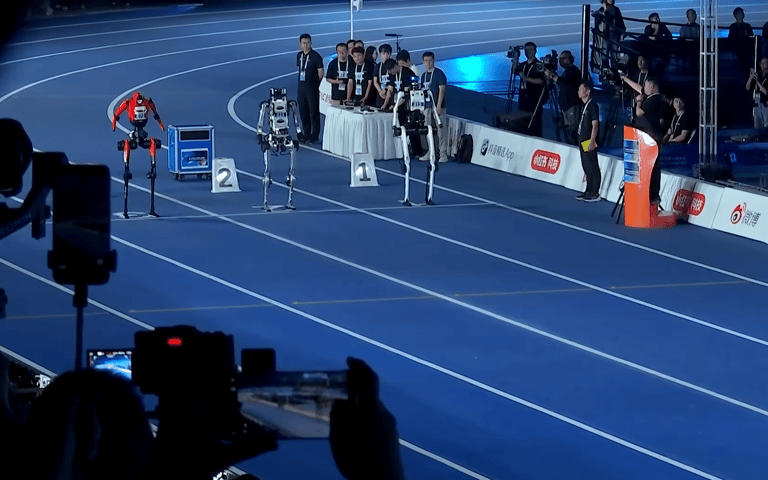


Beijing hosted the World Humanoid Robot Games, where humanoid robots delivered sprinting and high-jump performances rivaling human records and underscored rapid progress in robotics.
The event featured a wide array of disciplines, from free combat and table tennis to 400m and 1500m races, tug-of-war, dancing, and cheerleading finals, with imagery spanning multiple August 2026 dates.
More than 2,000 robots from 666 teams, mainly Chinese, competed across 51 disciplines that span sports, factory simulations, restaurant, office, and emergency task simulations.
Industry deployment emphasizes common interfaces and safety standards, with concerns about perception disruption from reflections and dust, as well as durability, heat management, and component longevity under continuous operation.
Practical deployment challenges highlighted in the draft include dust, reflections, heat, durability, and prolonged operation, reinforcing the need for robust safety and user interfaces.
Success in robotics will hinge on turning core technologies into widely adopted industry solutions and shaping global rules, not merely piling up patents or standards.
Brokers are advised to probe clients about hardware origin, FCC eligibility, software-incidents liability coverage, indemnification contracts, employment-modification effects on workers, and availability of device data for claims handling.
The broader thesis suggests the biggest wins in physical AI will come from solving topology discovery, actuator-level safety, and secure networking, rather than chasing raw AI benchmark speeds, with distributed nervous systems seen as the path to profitability.
Caveats remain: earlier configurations relied on external motion-capture for ball tracking, and details of the current WHRG sensor setup were not fully disclosed.
The project is framed as a path to broader industrial innovation with ongoing collaboration to strengthen uplink capabilities, spectrum coordination, and differentiated service for multimodal device-to-cloud transmission.
Technically, the work unifies visual perception, state estimation, bipedal locomotion, and physical interaction into a single end-to-end policy designed to operate under noisy, delayed, and occluded conditions.
Despite regulatory and geopolitical headwinds, investors expect demand-driven deployment to continue, as firms leverage mature hardware to create unique applications and maintain competitive advantages.
Summary based on 116 sources
Get a daily email with more World News stories
Sources
Ai-Ai-OH • Aug 27, 2026
Malfunctions Worth Gold at the Robot Olympics
Yahoo! Finance • Aug 25, 2026
9.32 Seconds: TianGong Ultra Surpasses the Human World Record in the 100-meter Race!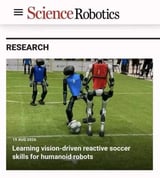
Yahoo! Finance • Aug 21, 2026
Booster Robotics Powers Science Robotics Research Article on Vision-Driven Humanoid Soccer Skills
Ars Technica • Aug 25, 2026
World humanoid robot games show runners breaking records, bursting into flames