Mastering Distributed Locks: Ensuring Consistency and Reliability with Redis and Beyond
September 26, 2026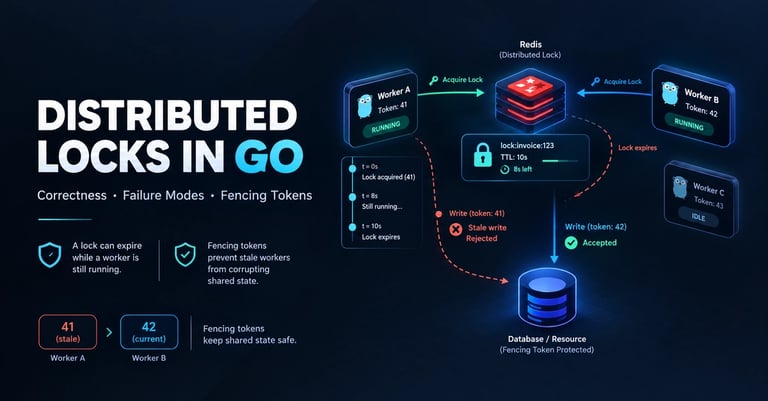

A complete lifecycle for a long-running task begins with acquiring a lease, obtaining a fencing token, starting work, renewing the lease as needed, stopping writes if renewal fails, and releasing the lock only after confirming ownership remains valid.
Redlock, which uses multiple Redis masters, is discussed as a mitigation strategy but it is not a guaranteed solution; assess the actual consistency guarantees you need and consider alternatives like database locks or queue-based ownership when appropriate.
Observability is essential: track acquisition attempts, latencies, renewals, releases, and ownership transitions, and log meaningful events with context to diagnose failures and contention.
A distributed lock in Redis is more complex than a local mutex because it coordinates across processes, introduces failure modes such as crashes, network issues, and clock differences, and requires careful ownership and lifecycle design.
TTL choice is a correctness decision: too-long TTL risks stale work; too-short TTL risks deadlocks from slow tasks; renewal adds complexity and must integrate with the worker’s lifecycle and cancellation.
Considerations include context-aware acquisition with deadlines, distinguishing between locks, queue ownership, or leader election, and recognizing when a distributed lock may not be the right tool for the problem.
A basic pattern uses SET with NX and an expiration to acquire a lock, with a unique owner token to establish ownership and prevent releasing another’s lock; release must be atomic and owner-checked (often via a Lua script) to avoid races.
Long-running work that can outlive the lock TTL requires strategies like renewal and careful handling of renewal failures and cancellation so the system can stop writes when the lease is lost.
Fencing tokens ensure downstream operations can distinguish newer versus older work even after a lease expires; they are separate from lock ownership tokens and are enforced by updating the resource with a monotonically increasing token.
Summary based on 1 source
Get a daily email with more Tech stories
Source

DEV Community • Sep 26, 2026
Distributed Locks in Go: Correctness, Failure Modes, and Production Patterns