Sceye's Record-Breaking HAPS Flight Revolutionizes Disaster Response and 6G Communications
October 19, 2026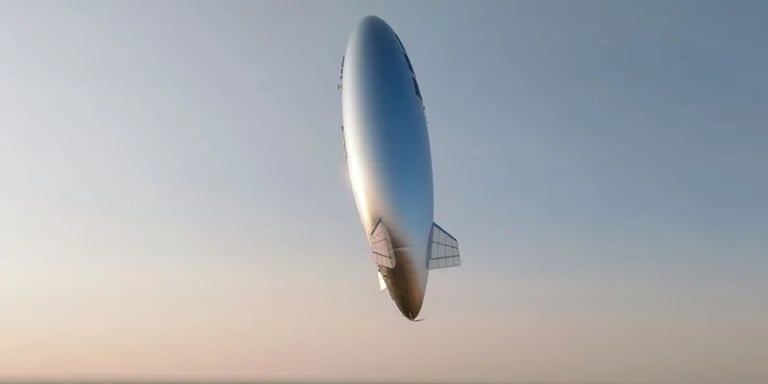

Sceye tested a stratospheric high-altitude platform system (HAPS) designed to act as a sky-based cell tower by flying in the stratosphere around 16.5 kilometers and delivering mobile broadband to ground devices.
The tests included legible demonstrations for disaster scenarios such as earthquakes and tsunamis, and involved collaboration with the Japan Coast Guard to support emergency communications, including the 118 emergency number.
Advances such as graphene-based materials have contributed to hull strength, energy density, and solar efficiency, enabling improved performance over earlier iterations.
The company conducted a trans-Pacific round trip, launching from New Mexico in August 2026 and returning from Japan in September 2026, covering roughly 30,000 kilometers over about a month.
The flight demonstrated autonomous navigation capable of routing around weather and providing station-keeping over a target area, with human operators monitoring weather and flight simulations; the mission ST1 was the longest test flight to date.
Current prototypes have flown with payloads over 100 kilograms and can deliver up to 1 kilowatt of power, with future designs targeting 250 kilograms.
SoftBank and Sceye will use the trial data to advance toward commercialization of HAPS in Japan from 2027 onward, focusing on operational frameworks and improvements in communications quality.
HAPS-to-drone communications were validated, enabling remote-controlled drone flight, location transmission, and video transmission via the HAPS to support a three-dimensional communications network for aerial mobility and disaster response.
Researchers explored optical wireless communications (laser links) between the stratosphere and ground stations, and the concept of acting as a relay to connect space-based assets with ground infrastructure, potentially contributing to 6G architectures and disaster resilience.
SoftBank Corp partnered with Sceye to test live service delivery during simulated outages, including voice, messaging, browsing, video calls, emergency alerts, and drone control via LTE links.
The trials featured the world’s first successful technical verification of HAPS-based edge computing, achieving an average 68 ms round-trip latency, reducing latency by over 40% compared with cloud processing.
Broader implications include disaster response readiness and rapid restoration of communications in underserved areas, with plans indicating multi-month to year-long missions rather than short tests.
Summary based on 3 sources
Get a daily email with more Tech stories
Sources
Ars Technica • Oct 19, 2026
Stratospheric airship flew from US to Japan to test sky cell tower concept

Northeast Times • Oct 19, 2026
New Mexico Airship Flies to Japan and Back to Test a Cell Tower in the Sky - Northeast Times