Flock’s License Plate Cameras Track Millions of Vehicles, but Oversight and Disclosure Remain Uneven
November 9, 2026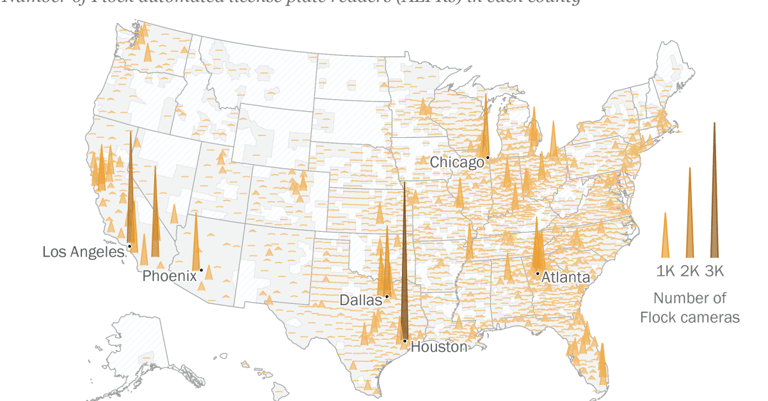

Flock Safety’s automated license plate readers photograph passing vehicles, and when cameras are networked, agencies can use them to reconstruct a vehicle’s movements over days or weeks; documented misuse has fueled proposals for tighter regulation or bans.
The size of Flock’s camera network is uncertain: Flock said it had more than 120,000 cameras in August 2026, while OpenStreetMap listed roughly 110,000 and an independent surveillance map identified as many as 175,000.
OpenStreetMap data current as of Sept. 17, 2026, places 49% of mapped Flock cameras in California, Texas, Georgia, Florida and Ohio; Georgia, Ohio and Texas have the most cameras per capita, and about 80% of mapped cameras are in urban areas.
Atlanta and Houston each have more than 4,000 mapped cameras, while Los Angeles, Chicago and Dallas-Fort Worth each have more than 3,000; cameras appear across communities of varying incomes and racial compositions, though they are slightly more common in lower-income neighborhoods.
As of Sept. 21, 2026, EyesOnFlock tracked 1,517 agencies with public transparency portals listing 39,465 cameras, or 36% of those mapped on OpenStreetMap; disclosure varies sharply, covering just 6% of mapped cameras in Florida and 2% in Pennsylvania.
Among agencies with portals, 93% disclose camera totals and 96% disclose data-retention periods; the median agency lists 12 cameras and retains data for 30 days, while Flock reduced its default retention period to seven days in August 2026.
OpenStreetMap identifies an owner or operator for only 12% of mapped cameras, and the analysis cautions that its crowdsourced data is incomplete and uneven across regions.
Only about half of agencies in the EyesOnFlock database share any information about search activity; among searches with a recorded reason, “investigation” or a related term is the most common, appearing in 19%.
USA Today’s September 2026 investigation found that logs from 120 agencies across 24 states recorded 75 million searches over three and a half years, covering nearly 4 million unique plates—about 59,000 searches a day; Flock replaced its open-text search-reason field with a drop-down menu and said it would require a case number for every non-emergency search by the end of 2026.
About two-thirds of agencies with portals disclose data-sharing practices, and those that do report sharing with a median of 217 organizations, mainly other law enforcement agencies; sharing is largely within California but can span dozens of states in places such as Florida and Ohio.
Summary based on 1 source
Get a daily email with more Tech stories
Source
Pew Research Center • Nov 9, 2026
What We Know – and Don’t Know – About Flock’s License Plate Cameras