Huang’s Exit Won’t Derail AI Boom, Cramer Says, as Nvidia Faces China Risks and Heavy Commitments
November 16, 2026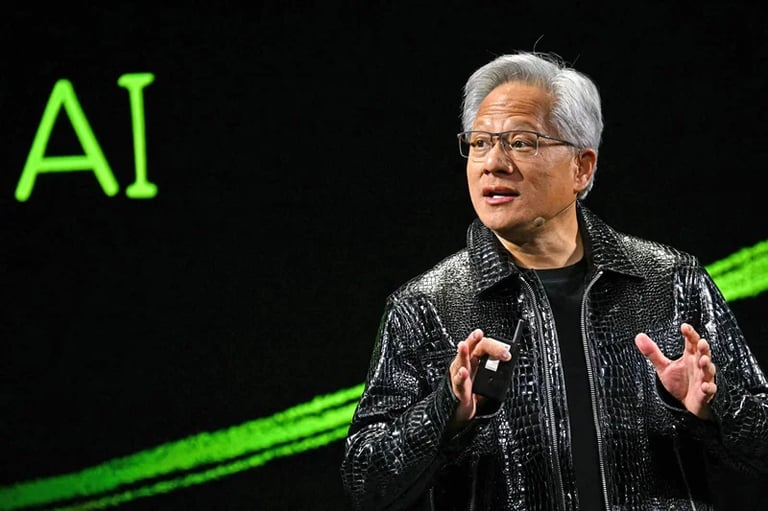

NVIDIA disclosed that Jensen Huang resigned as president, CEO and director effective immediately on Nov. 12, 2026; Colette Kress became interim CEO and Harvey C. Jones became board chair, while the company said its operations, customer commitments and product roadmap would continue without interruption.
Jim Cramer argued Huang’s departure would not derail the AI boom, because investment and GPU demand are driven by broader industry and corporate conditions, even as AI-related stocks sold off.
NVIDIA shares fell 31.9% from a record $239.24 on Oct. 6 to $162.85 on Nov. 13, though the average analyst price target remained $279.63.
Cramer said he expected Kress to give a measured outlook when NVIDIA reported earnings Tuesday night and did not anticipate her remarks would trigger a major wave of selling.
Cramer expects Kress to be more financially conservative and potentially reduce some guarantees, which could pressure heavily indebted companies, but he said persistent demand for computing power should sustain AI infrastructure investment.
Hanwha Investment & Securities researcher Park Joon-young said Nvidia’s customer financing is a company-level strategy, not a policy dependent on Huang personally, and expected the company to honor existing commitments, which had reached $36 billion.
Nvidia has supported companies and projects through investments and financial guarantees, including stakes in Intel and CoreWeave and a reported $105 billion backstop for an OpenAI data-center project; JPMorgan strategist Michael Cembalest estimated broader commitments may total $530 billion.
To limit the investment burden it carries directly, Nvidia is pursuing an infrastructure financing platform with Apollo, BlackRock and Blackstone that aims to mobilize more than $500 billion in external capital.
Evidence of committed infrastructure demand includes roughly $2.48 trillion in contracted backlog at Microsoft, Oracle, Amazon and Google Cloud, as well as large non-cancellable commitments at Meta and signed data-center leases at Microsoft that have yet to start.
Nvidia projected that supply constraints would persist through at least fiscal 2028, with demand projections about twice that year’s revenue and secured supply capacity supporting roughly 70% growth; demand is also spreading beyond hyperscalers to neocloud providers and enterprises.
Park acknowledged that proposed U.S. restrictions could reduce Nvidia’s China-related demand, including purchases routed through third countries, but said global demand for advanced accelerators and ongoing supply constraints should limit the impact.
U.S. export controls pose a more immediate threat to NVIDIA’s China business than Huang’s departure: revenue from mainland China and Hong Kong fell to $19.677 billion in fiscal 2026 from $25.048 billion the previous year.
Summary based on 6 sources
Get a daily email with more Tech stories
Sources
CNBC • Nov 16, 2026
Jim Cramer says Nvidia’s leadership shake-up won’t derail the AI trade
Gasgoo Auto News • Nov 16, 2026
Jensen Huang Resigns: NVIDIA Stable in China for Now, but What About the Long Term?
BigGo Finance • Nov 16, 2026
Nvidia CEO Change, China Curbs Leave Memory Demand Solid; Hanwha Says "Positive on South Korean Semiconductors"