Unseen Civil Rights Photos Reveal Rosa Parks' Activism Beyond 1955, Reconnect Marion Families to History
December 7, 2025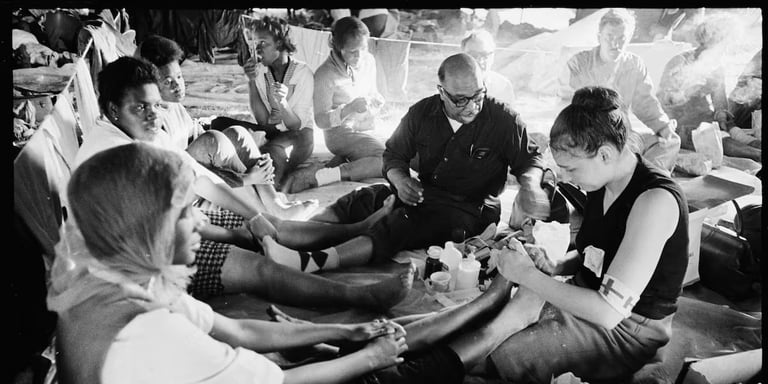

Local families, such as Cheryl Gardner Davis, view the new images as validation and a means to recount and honor those who hosted and supported march participants.
Anecdotes recall hardships faced by hosting communities, including damage to livelihoods and safety threats, highlighting the broader social costs of the movement.
Organizers and descendants gathered in Montgomery and Alabama communities to reconnect with the photos and the people depicted, contextualizing history for local audiences and families.
Public display drew Alabama community members and Civil Rights veterans, linking historical memory to contemporary understanding and local family histories.
The narrative shifts Parks from a single act in 1955 to a sustained activist role through the 1965 march and beyond.
The Selma-to-Montgomery march was a five-day, 54-mile effort that helped galvanize momentum for the Voting Rights Act of 1965, providing historical context for these images.
Historically, the march is credited with catalyzing support for the Voting Rights Act of 1965, and the release of these images highlights the broader network of people behind civil rights efforts.
The reunion-style viewing took place at Lincoln Normal School in Marion, Alabama, where residents recognized familiar and new faces from the march.
Parks’s legacy is framed as broader than a single act, reflecting sustained civil rights engagement through the 1960s and beyond, aligning with the museum’s mission to educate about her full life and impact.
Jeannine Herron and historians are coordinating to reintroduce the photos to communities, emphasizing education and connection to local histories and Parks as both person and activist.
Jeannine Herron, Matt Herron’s widow, works with historians and Alabama activists to reconnect the public with the photographers’ work and the communities depicted.
Newly released, never-before-seen photographs by Civil Rights photographer Matt Herron depict Rosa Parks and others during the 1965 Selma to Montgomery march, expanding the image of Parks beyond the 1955 bus boycott.
A personal reunion accompanies the release as Doris Wilson reconnects with medical volunteer Dr. June Finer, who treated her blisters during the march, underscoring the intimate, human side of the historical narrative.
The rediscovery and display of these images aim to deepen understanding of the Civil Rights Movement by highlighting the broader community effort and individual stories that sustained the march.
Marion residents, including Wilson, describe how the 1965 march affected families, with long-term consequences like threats to jobs and property, illustrating the personal costs of civil rights activism.
The events occurred during the three weeks around the 1965 Selma to Montgomery march, with public release and viewing timed to precede anniversary commemorations.
Summary based on 7 sources
Get a daily email with more World News stories
Sources
NBC News • Dec 7, 2025
Never-before-seen photos of Rosa Parks resurface in Montgomery seven decards later
AP News • Dec 7, 2025
Rosa Parks' unseen photos shed light on civil rights history | AP News
U.S. News & World Report • Dec 7, 2025
Unseen Photos of Rosa Parks Return to Montgomery, Alabama, Seven Decades Later