South Korea Approves $350 Billion U.S. Investment Framework, Boosting Bilateral Trade and Regional Stability
March 13, 2026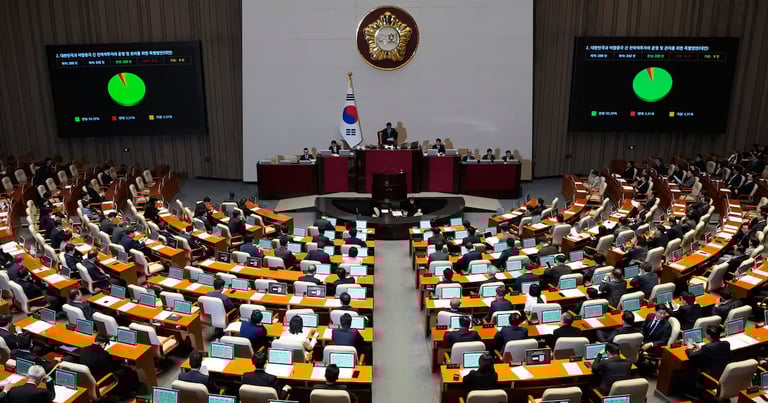

Fund management will be transparent: assets and investment performance must be publicly reported annually, and parliamentary pre-approval will occur before consulting with the U.S. on candidate projects.
Officials said the U.S. probe into manufacturing is within expectations, with ongoing talks to preserve tariff balances amid broader geopolitical tensions.
The bill, submitted last November and passing 226 to 8, creates an oversight structure to select projects aligned with a broader U.S.-Korea investment agreement, while aiming to protect against coercion and ensure commercial feasibility.
Leaders reaffirmed openness to dialogue with North Korea and discussed collaboration in sectors such as nuclear energy and critical minerals as part of broader regional stability efforts.
The new corporation will employ about 50 people and operate a three-member board, with at least 10 years of experience in finance or strategic industries to prevent cronyism.
Priority sectors for the investment plan include shipbuilding, semiconductors, pharmaceuticals, critical minerals, energy, AI, and quantum computing, with room to add sectors by presidential decree.
A joint U.S.-Korea committee and a Finance Minister-led mechanism will assess and decide which projects to advance to a U.S. panel for final consideration.
Initial government capital for the corporation is about 2 trillion won, backed by a governance structure including a risk management committee to monitor exposures.
The bill requires commercial feasibility for investments, with exemptions for national security or supply chain stability subject to parliamentary approval.
South Korea’s National Assembly approved a framework to implement Seoul’s pledge of $350 billion in U.S. investments, establishing a public corporation to manage and review projects with input from Korean and U.S. trade authorities.
Beyond investments, talks cover civil uranium enrichment, spent fuel reprocessing rights, and joint efforts to revitalize U.S. shipbuilding.
Prime Minister Kim Min-seok and U.S. Vice President Vance met in Washington to discuss the legislation as a key step in implementing the trade deal and strengthening bilateral cooperation.
Summary based on 24 sources
Get a daily email with more World News stories
Sources
Reuters • Mar 12, 2026
South Korean parliament approves $350 bln US investment bill
U.S. News & World Report • Mar 12, 2026
South Korean Lawmakers Pass Law to Manage Seoul's Pledge of $350 Billion in US Investments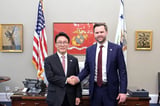
ST • Mar 13, 2026
South Korea says US V-P Vance welcomes Seoul’s investment Bill