Deepest Whale Graveyard Uncovered: A 1,200km Archive of Marine Life in the Indian Ocean
June 10, 2026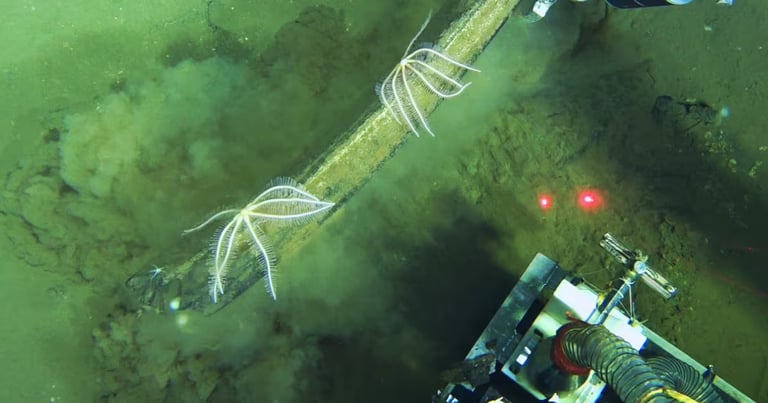


The reporting is led by Stephen J. Godfrey, affiliated with the Maryland State Paleontology Collections and Calvert Marine Museum, signaling a solid paleontological reporting perspective.
Related coverage notes advances in bioproduct chemistry through studies turning plant material into chemical building blocks.
Researchers have uncovered the deepest and largest whale necropolis to date, spanning roughly 1,200 kilometers along the Diamantina Fracture Zone in the southeastern Indian Ocean, with nearly 500 whale fossils found between 4,200 and 7,000 meters depth.
Natural causes combined with the site’s distinctive V-shaped seabed geometry helped whales accumulate and become preserved in this area, making it a long-lasting deep-sea archive.
The graveyard hosts a diverse array of life, including jellyfish, tubeworms, brittle stars, sea cucumbers, squat lobsters, and saltwater clams, suggesting many potentially undocumented species.
The discovery is presented within a broader scientific context, with access to the Nature publication and related references, and ongoing Nature News & Views coverage.
The article structure provides a quick overview, research highlights, and a discussion of how these findings fit into larger scientific narratives, with pointers to related works.
The Nature paper detailing the findings has been published, and independent experts regard the discovery as a notable, novel contribution to paleontology.
An international team from China, Italy, and New Zealand conducted the expedition; the study underscores the extreme, lightless, high-pressure deep-sea environments that host surprising biodiversity.
Remote deep-sea environments like these whale necropolises reveal vibrant communities and demonstrate the resilience of life under extreme conditions.
Supplementary material in related episodes covers broader research highlights, including other studies on early life indicators and even unrelated topics like birth weight influences in different contexts.
Key researchers include Xiaotong Peng, Peng Zhou, and Xikun Song, who describe the finding as revealing deep-sea life and history rather than a barren abyss.
Summary based on 24 sources
Get a daily email with more World News stories
Sources
AP News • Jun 10, 2026
Underwater whale graveyard is home to jellyfish and bone-eating worms | AP News
Gizmodo • Jun 10, 2026
Scientists Have Just Discovered a 5 Million-Year-Old Whale Necropolis in the Deep Sea
Yahoo News • Jun 10, 2026
Scientists discover a deep whale graveyard that is teeming with life
The Guardian • Jun 10, 2026
Deepest and most extensive whale graveyard discovered in Indian Ocean