US Naval Drills Showcase Advanced Ship-Sinking Tactics with Stealth Bombers and Drones
August 25, 2026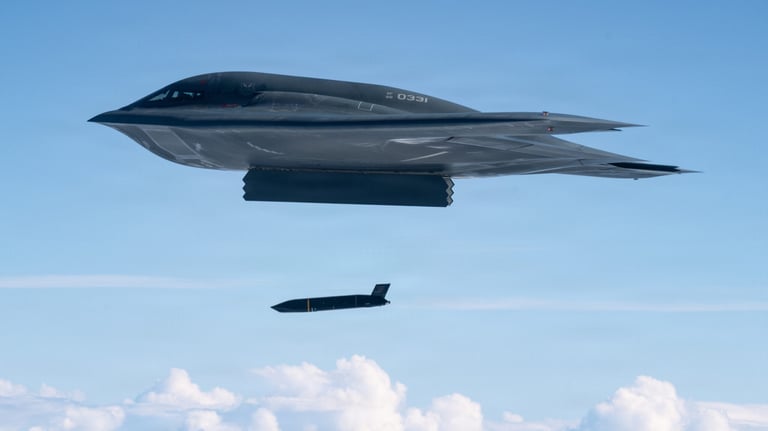

The United States demonstrated expanded ship-sinking capabilities in summer Pacific naval exercises, including long-range anti-ship strikes from stealth bombers and the use of unmanned boats against targets.
Valiant Shield unified US forces with Japan, Canada, New Zealand, and Australia to practice joint detection, tracking, and engagement across air, sea, space, land, and cyberspace.
USV Division 32, one of three newly established units, operated and sustained unmanned surface vehicles and participated in a live-fire SINKEX, signaling ongoing integration of USVs into naval combat.
During Valiant Shield, a B-2 bomber launched an AGM-158C LRASM at the decommissioned ship Juneau, marking the first public LRASM launch from a B-2 and highlighting stealthy, long-range anti-ship reach.
Unmanned Surface Vessels called Global Autonomous Reconnaissance Crafts were used at RIMPAC for a SINKEX, with a GARC surveying Peleliu before the strike; Lt. Sarah Weinstein identified the GARC as built by BlackSea Technologies.
RIMPAC 2026 featured sinking exercises off Hawaii, with the decommissioned Mobile Bay and Peleliu sunk on July 17 using submarine-launched torpedoes and missiles like LRASMs, Spike NLOS, and NSMs.
The LRASM launch from the B-2 underscored the advantage of internal bomb bays for stealth in contested Pacific airspace, emphasizing adaptability and counter-maritime strike operations to keep the Pacific open.
Overall, the exercises showcased evolving US capabilities—long-range, stealth, unmanned, and multi-domain operations—while reinforcing alliances and real-world proficiency across air, sea, and cyber kill chains.
Summary based on 1 source
Get a daily email with more World News stories
Source
Breaking Defense • Aug 25, 2026
US flexes new ship-sinking weapons at summer naval exercises