Brazil's Tight Presidential Runoff: Bolsonaro Leads, Lula Fights Back Amid Economic Concerns
October 8, 2026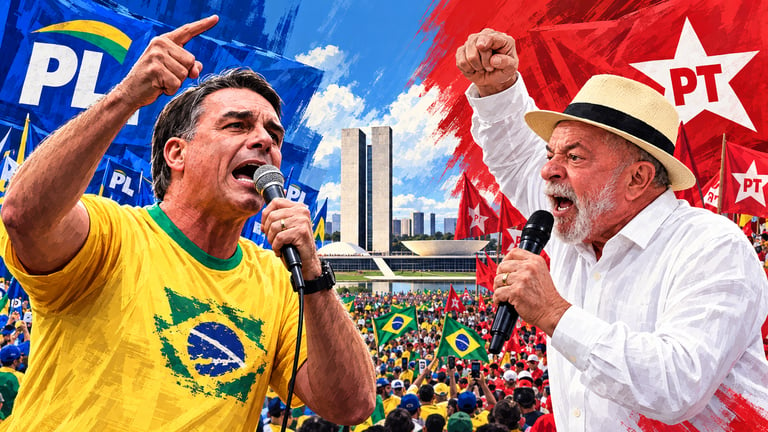

Brazil’s presidential race moved into a tight runoff after the first round on Oct. 4, 2026, with conservative Senator Flávio Bolsonaro leading at 47.03% of valid votes and President Luiz Inácio Lula da Silva at 45.16%.
Bolsonaro won roughly 56.1 million votes in the first round, while Lula captured about 53.9 million, as the field narrowed to a head-to-head battle.
Analysts say voter concerns around inflation, public safety, and economic uncertainty are shaping the race, though these issues vary by country.
The region shows non-uniform shifts, with Mexico and Uruguay still governed by left-leaning administrations despite Brazil’s tight race.
The runoff dynamics will hinge on mobilizing abstentees, reallocating votes from eliminated candidates, and Lula energizing his base against Bolsonaro’s momentum.
Economic conditions and political momentum ahead of Oct. 25, 2026, are poised to influence the runoff outcome as votes redistribute from those who did not advance.
Brazil’s election is viewed as a barometer for rapid shifts in Latin America’s political alignments amid diverse national contexts.
Campaigns have moved to win over supporters of eliminated candidates, notably Augusto Cury endorsing Bolsonaro on Oct. 8, potentially shaping the runoff dynamics.
Lula advocates strategic autonomy and balanced relations with the US, China, and BRICS, while Bolsonaro pushes closer US ties and continued economic links with China; policy shifts aren’t automatic should candidates prevail.
Other candidates trailed in the first round, including Augusto Cury at 2.89%, Renan Santos at 2.24%, and Ronaldo Caiado at 2.18%, among about 119.3 million valid votes cast.
Bolsonaro’s party, the Liberal Party, won 121 seats in the Chamber and increased Senate representation to 28, with allies potentially giving a broader coalition could total around 259 Chamber seats and 48 Senate seats.
Support from right-wing figures like Romeu Zema and Ronaldo Caiado helped Bolsonaro gain momentum after the first round.
Summary based on 2 sources
Get a daily email with more World News stories
Sources


ElReporterosf.com • Oct 9, 2026
Brazil's election surprise tests Latin America's political pendulum - ElReporterosf.com