Delhi Chokes Under Toxic Smog: PM2.5 Levels 30 Times the Safe Limit
November 4, 2026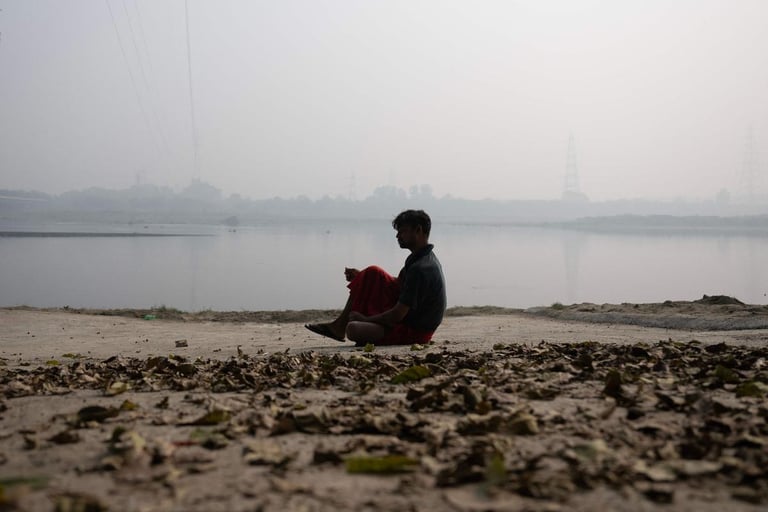

Diwali firecracker smoke added to New Delhi’s seasonal pollution, with the air quality index exceeding 350 in several areas on Monday morning—a level classified as severe and harmful to health.
Cool temperatures, weak winds and frequent temperature inversions are trapping pollution near the ground instead of allowing it to disperse.
As the smog worsened, Environment Minister Manjinder Singh Sirsa and Transport Minister Pankaj Singh directed half the employees in departments under their charge to work from home, aiming to reduce traffic.
The directions came as Stage III of the Graded Response Action Plan was in force across Delhi-NCR; it asks regional governments to consider having public, municipal and private offices operate with half their staff on site.
Schools through Class 5 in Delhi, Noida, Ghaziabad, Faridabad, Gurugram and Sonipat were directed to hold classes in mandatory hybrid mode, combining online and in-person teaching.
The work-from-home order covers Delhi, Gurugram, Faridabad, Sonipat, Ghaziabad and Gautam Buddha Nagar, while exempting essential services and industrial operations where remote work is not feasible.
Authorities are using emergency steps such as work-from-home mandates and restrictions on trucks and older vehicles, alongside longer-term plans to phase out older vehicles, expand cleaner fuels and close regional coal-fired power plants.
Construction limits and restrictions on diesel generators and firecrackers have also been tried, but severe pollution returns each year; public health expert Shweta Narayan described the response as “knee-jerk” and “temporary” and called for cleaner energy and stricter vehicle-emission controls.
Water-sprinkler trucks are being used to control road dust, but residents say the relief lasts less than an hour and does little to address fine particles or dust stirred up by traffic and construction.
Manoj Kumar of the Centre for Research on Energy and Clean Air reported 227 missing hourly PM2.5 observations across 59 Central Pollution Control Board stations between midnight on November 8 and 5 a.m. on November 9; only 14 stations had complete data, while 45 had at least one missing reading.
The CPCB said its automated system excludes hourly readings outside the calibrated range, causing apparent gaps during occasional extreme pollution episodes, and denied deliberately underreporting pollution.
Kumar warned that missing hourly readings can make the Air Quality Index appear artificially low and said the CPCB public portal capped displayed PM2.5 readings at 1,000 micrograms per cubic metre, obscuring higher concentrations.
Summary based on 50 sources