US, Russia and China Set for First Nuclear Arms Control Talks as New START Expires
November 16, 2026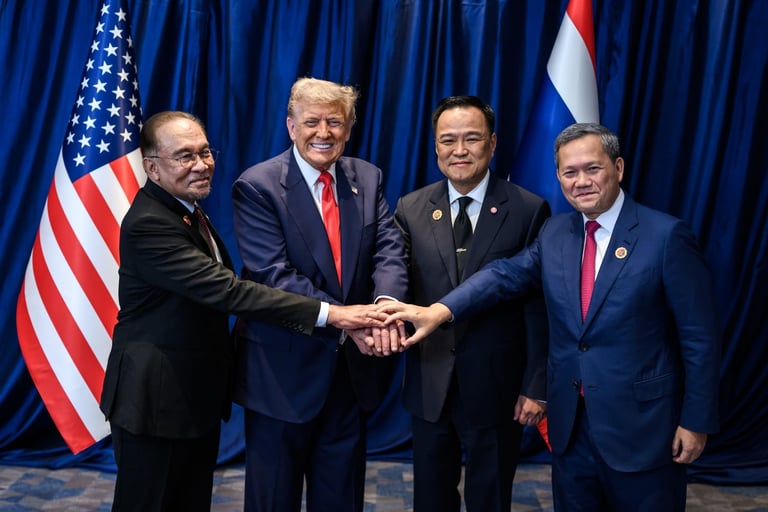

With New START expiring in February 2026, Donald Trump is pushing for a new nuclear arms control agreement involving the United States, Russia and China, and the three countries are expected to hold their first trilateral meeting alongside the APEC summit in Shenzhen.
New START, signed in 2010 and extended in 2021, capped US and Russian deployed strategic warheads at 1,550 each and limited certain missiles, launchers and bombers; its expiration ended the last major agreement constraining their strategic arsenals.
Washington argues that a successor must include China because its nuclear arsenal is growing, with Marco Rubio saying a meaningful 21st-century deal cannot exclude Beijing.
China says it will not join disarmament negotiations at this stage, arguing that its estimated 620 warheads are far fewer than the 5,042 held by the United States and 5,420 by Russia, so comparable obligations would be disproportionate.
That arsenal is expanding by about 100 warheads a year, according to the Stockholm International Peace Research Institute, while limited transparency makes its intended scale and purpose difficult to assess.
Chinese analysts say Beijing sees its no-first-use policy and minimum-deterrence posture as sufficient restraint, and fears a treaty could limit its smaller force without addressing US missile defenses, precision-strike capabilities and other concerns.
Beijing also distrusts Washington’s commitment to arms control, citing past US withdrawals from treaties, and sees its nuclear capability as protection against coercion; analysts say it wants to preserve its modernization and strategic autonomy.
Analysts say meaningful negotiations may require the United States and Russia to reduce their arsenals toward parity with China, with incremental steps such as strategic-stability dialogues, test moratoria, data exchanges and advance notice of major exercises offering a possible starting point.
Any workable agreement may need different obligations and phased verification for countries with unequal arsenals, while addressing missile defense, advanced conventional weapons, crisis communication, nuclear doctrines and human control of AI-enabled nuclear systems.
Political distrust, the war in Ukraine, tensions over Taiwan and US military deployments in the Asia-Pacific make a formal treaty unlikely soon; analysts consider informal restraints more plausible in the near term.
The expected talks are part of Trump’s Asia trip, which includes regional meetings in Manila and the APEC forum in Shenzhen, where he is scheduled to meet Xi Jinping.
Earlier arms-control efforts included START I, the unimplemented START II and the 2003 Strategic Offensive Reductions Treaty; inspections and verification weakened during the COVID-19 pandemic and were further disrupted by Russia’s 2022 invasion of Ukraine.
Summary based on 3 sources
Get a daily email with more World News stories
Sources
Al Jazeera • Nov 16, 2026
Why is China resisting a nuclear treaty with the US and Russia?
Outlook India • Nov 16, 2026
Can Trump Bring China and Russia Together for a New Nuclear Arms Treaty?
The 420.in • Nov 16, 2026
Trump Seeks Nuclear Arms Control and North Korea Outreach During APEC Visit to China - The 420.in