China, Russia, Iran and North Korea Are Coordinating—and Testing a Weakened West
November 23, 2026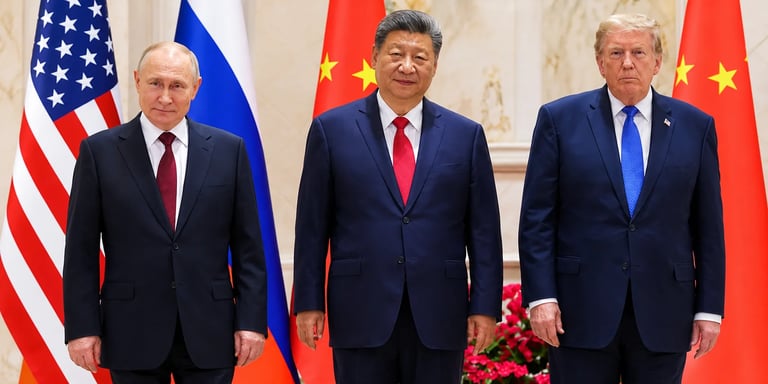

The Economist argues that a meeting in Shenzhen between Donald Trump, Xi Jinping and Vladimir Putin was not a historic, Yalta-style pact; the bigger concern is growing informal coordination among China, Russia, Iran and North Korea as U.S. alliances weaken.
Though the four regimes differ sharply in economic power and political structure, The Economist says they share an aim: creating a world where autocratic governments feel secure.
Their interests do not always align: China depends on global trade and stability and disapproves of North Korean provocations, but opposition to the United States can override those differences, particularly when U.S. resources are diverted from the Pacific.
Military ties are a major part of the relationship: Russia uses Iranian drones and Chinese components against Ukraine, Iranian engineers study Russian battlefield improvements, and North Korea has sent about 16,000 troops to fight alongside Moscow in exchange for money and defense technology.
China says it does not directly supply weapons, but it collects data on Russian drone operations; Iranian missiles aimed at U.S. forces in the Persian Gulf also depend on Chinese chemical precursors and navigation technology, as well as Russian intelligence.
Energy and labor links further bind the countries: Russian oil goes to China and North Korea, Iranian oil reaches Chinese ports via a shadow tanker fleet that has grown 1,500% since 2022, and North Korean workers staff Russian factories.
China also helps sanctioned states evade Western restrictions through payment systems, with more than 95% of Russia-China trade now conducted in yuan and rubles, up from about 25% five years earlier.
At the United Nations, China and Russia coordinate Security Council vetoes, while state propaganda across all four countries amplifies narratives against Western democracies.
The Economist warns that the risk recalls the 1930s, when Germany, Italy and Japan created simultaneous crises in different regions; a Chinese attack on Taiwan, it says, could coincide with conflict elsewhere or a major AI-enabled cyberattack.
The editorial says authoritarian states may be less effective than liberal democracies at producing prosperity and innovation, but their coordination can make the world more dangerous and calls for a concerted response from democratic countries.
Summary based on 1 source