Google Maps Unveils AI-Powered EV Trip Planning on Android Auto, Expands Charging Efficiency
March 30, 2026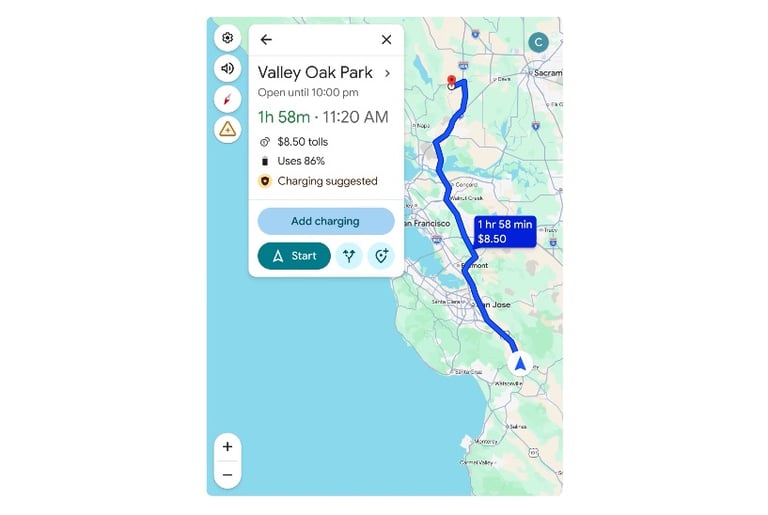

Wall Street analysts view Alphabet favorably, with a Strong Buy across multiple firms in recent months.
Google Maps on Android Auto now includes AI-powered EV trip planning that suggests charging stops, estimates arrival battery level, and updates ETA based on charging time, built to reduce range anxiety.
The system uses AI with energy models that account for vehicle specifics like weight and battery size, and integrates real-time traffic, elevation, and weather to improve accuracy.
Users enter their destination and starting battery percentage; Maps displays charging stations along the route, suggests dwell times at chargers, and estimates post-charging battery levels.
Investor context shows substantial institutional ownership at about 66%, with insider ownership around 1%, signaling confidence from large holders but limited insider stake.
Financially, revenue stands at about $187.3 billion with 6.1% three-year growth, yet operating and net margins are negative (-4.9% and -4.37%), while EBITDA margin sits at 1.94%.
Ford is highlighted as a key player in the rollout, with hundreds of models in the U.S. market expected to be covered as the feature expands.
The update builds on a CES 2024 feature, expanding AI integration and vehicle support, now covering more than 15 brands with plans to add more.
Analysts’ average price target for Alphabet stock implies roughly 37% upside.
Google’s AI push includes Gemini integration across Workspace, Google TV, and AI features in Search, signaling broader AI strategy.
Compatibility checks via Google Maps support pages determine rollout, currently covering hundreds of models across over 15 brands with more coming soon.
Ford’s financials show high leverage (debt-to-equity 4.61) and modest liquidity, with metrics suggesting potential distress risk in the near term.
Summary based on 6 sources
Get a daily email with more Tech stories
Sources

Android Central • Mar 30, 2026
Get in: Android Auto EVs see AI battery predictions in Google Maps for stress-free plans
TeslaNorth.com • Mar 30, 2026
Google Maps AI Now Predicts EV Battery Life for 350 Android Auto Models | TeslaNorth.com
Digital Trends • Mar 30, 2026
Your Android Auto can now plan EV trips with AI-powered charging stops