Tesla Plans €3 Billion Berlin-Area Expansion to Build Up to 1 Million Cybercabs
November 16, 2026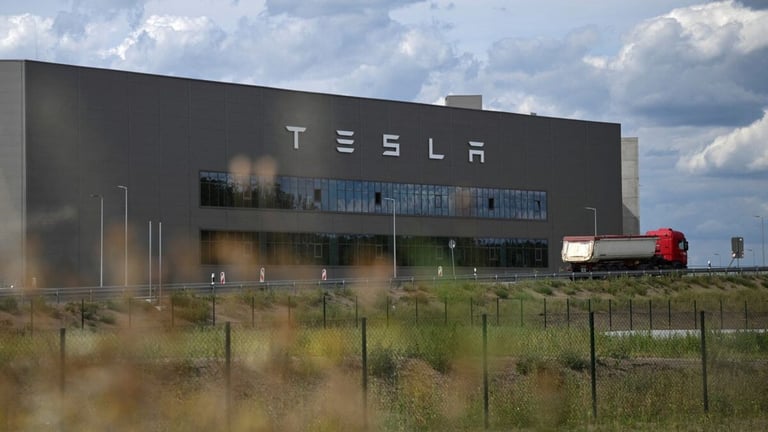


Tesla plans to invest €3 billion in expanding its Grünheide factory near Berlin, beginning with a new production building designed eventually to produce up to one million Cybercabs.
The proposed hall was previously reported to cover about 536,000 square meters—more than twice the current factory building—and would be built on Tesla-owned land without additional forest clearing.
Tesla expects construction to start in the first half of 2027 and production in 2029, with permits sought by the end of 2026; the company also plans to add several hundred workers.
The factory employed 12,600 people in October after staffing had fallen below 11,000, and Tesla said it had added 2,000 employees in recent months.
Opened in March 2022, Grünheide is Tesla’s only European factory and has faced environmental and permitting hurdles.
The expansion has drawn local and labor scrutiny: 65% of residents who voted in a non-binding 2024 referendum opposed an earlier, later-scaled-back plan, while IG Metall won about 13 of 37 works council seats in March.
Tesla’s local management has repeatedly clashed with IG Metall, which accuses the company of union-busting; Tesla says the union is serving its own interests, and IG Metall says the expected hiring could strengthen employees’ leverage to seek better conditions.
Tesla says the expanded site will stay within its agreed water limits, but residents and environmental groups have raised concerns about the factory’s location partly within a water-protection area.
Regulation is a major uncertainty for the Cybercab plan: EU rules currently allow approval of up to 1,500 fully driverless vehicles per type each year under the small-series route, and Tesla has no European approval for unsupervised driving.
Because the planned output far exceeds that current EU allowance, the project may depend on regulatory changes or exports; the factory’s plans still require permits, construction and a production ramp-up.
The investment is a high-risk bet on autonomous driving becoming commercially viable and legally approved at scale by 2029, though the new factory could potentially be adapted for other products.
Brandenburg Minister-President Dietmar Woidke welcomed the investment as an economically significant signal for Germany’s industrial sector, while officials said it could strengthen the region’s role as an automotive center.
Summary based on 29 sources
Get a daily email with more Tech stories
Sources

TechCrunch • Nov 16, 2026
Tesla goes all-in on the Cybercab with upcoming €3B Berlin Gigafactory expansion
Gizmodo • Nov 17, 2026
Tesla Wants to Build 1 Million Cybercabs in Europe. There’s Just One Problem.
Deutsche Welle • Nov 16, 2026
Tesla planning €3BN investment in German factory to produce Cybercabs
Investing.com • Nov 16, 2026
Tesla to invest €3 billion to expand Berlin factory for Cybercab