Tesla Unveils Major FSD v14.3 Update with AI Overhaul, Aiming to Revolutionize Autonomy and Tech Innovation
April 7, 2026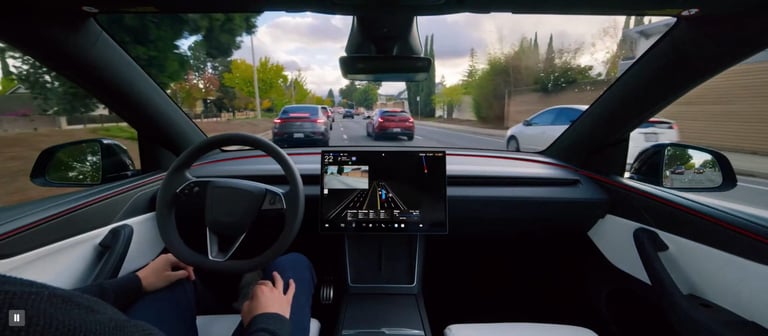

Tesla begins rolling out Full Self-Driving (Supervised) v14.3 (2026.2.9.6), underpinned by a foundational AI rebuild aimed at advancing its autonomy roadmap.
Foundational work is underway for autonomous parking and pothole avoidance, with plans to extend AI reasoning across all driving behaviors.
A parked car blind-spot warning can prevent door opening when an approaching object is detected, with a short override window available.
Industry observers, including Intel’s Lip-Bu Tan, see the update as potentially reshaping semiconductor manufacturing and broader tech innovation.
A patent outlines unsupervised data labeling and a Transformer-based method to fuse 2D images into a 3D occupancy map, supporting autonomous driving and potential humanoid robotics.
Analyses point to deeper Tesla patent coverage on FSD and occupancy networks for readers seeking technical detail.
Further features on the horizon include enhanced driver monitoring for longer hands-off driving while ensuring driver attention and autonomous parking capabilities.
Fleet learning enables the neural network to learn from difficult scenarios encountered by other Teslas using global fleet data, including rare events and hard reinforcement learning examples.
The release notes confirm FSD (Supervised) v14.3 with hardware 4 support across Model S, 3, X, Y, and Cybertruck, and are positioned as a major update tied to the company’s pursuit of higher autonomy.
CEO-led promotion positions v14.3 as the last major puzzle piece for the self-driving vision, with the update emphasizing an MLIR-based rewrite for faster reactions and broader AI reasoning.
Upcoming improvements include expanding AI reasoning to cover all driving behaviors beyond destination handling, pothole avoidance, and a more sensitive driver-monitoring system with improved eye-tracking under varying lighting.
Terafab will operate two facilities: terrestrial AI chips powering FSD and Optimus, and space-grade D3 chips for orbital data centers, with potential for around-the-clock solar operation.
Summary based on 7 sources
Get a daily email with more Tech stories
Sources

Electrek • Apr 7, 2026
Tesla FSD v14.3 rolls out with MLIR rewrite, 20% faster reactions
National Today • Apr 8, 2026
Tesla Unveils Major FSD Update with Fleet Learning and Faster Reactions - Austin Today
TeslaNorth.com • Apr 7, 2026
Tesla FSD 14.3 Launches with 2026.2.9.6 Update: Release Notes | TeslaNorth.com