Tesla's European Self-Driving Approval Faces Scrutiny Over Dubious Safety Claims
June 15, 2026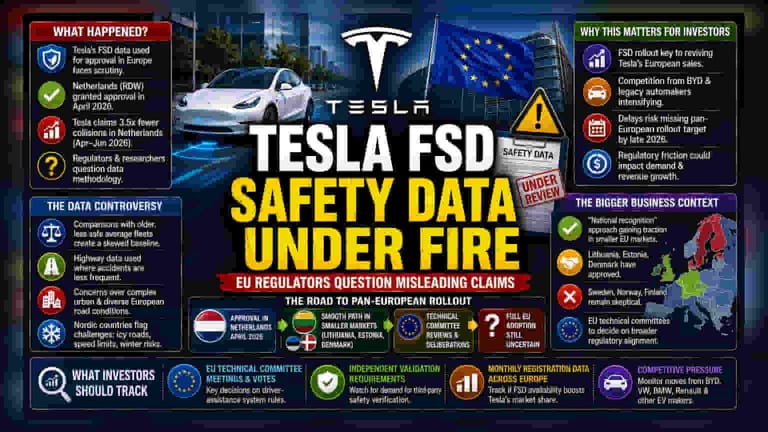

Tesla’s bid for European approval of Full Self-Driving has come under scrutiny as independent researchers say some safety statistics appear more marketing than rigorous evidence, casting doubt on the robustness of the data presented to regulators.
A narrative verified by Bloomberg and Reuters notes Tesla’s November 2024 letter to RDW linked to claims that greater FSD usage could reduce crashes, a premise that Dutch regulators subsequently allowed in the Netherlands after evaluation.
In the Dutch approval process, Reuters reports a presentation claimed FSD could travel seven times farther between crashes and could prevent roughly 1.9 million injuries and save 32,000 lives, estimates critics say rely on problematic comparisons and older vehicle baselines.
The broader concern emphasized is that managing user expectations and perception may pose as much risk as the software itself.
The piece situates Tesla’s move within a wider industry shift, noting automotive players courting defense contracts and evolving U.S. EV market dynamics amid policy changes, all while maintaining a skeptical tone on corporate narratives.
(Additional context sourced from agencies.)
RDW officials say they are still seeking clarifications from questions raised by media reports and have not publicly commented on the criticisms.
The closing anecdote about a personal story unrelated to the core regulatory arc underscores that some parts of the piece stray from the main topic.
Analysts caution that EU-wide approval is unlikely before year-end due to data concerns, regulatory caution, and mixed signals across Europe.
Regulators may require changes in labeling or extensive consumer disclosures that could blunt the marketing impact of “Full Self-Driving” in Europe and beyond.
Regulators note that self-generated data complicates real-world safety assessments, highlighting the need for rigorous independent verification and public trust.
Regulators insist on evaluating the full body of evidence rather than headline figures, as critics warn self-produced data may delay or complicate EU-wide approval.
Summary based on 28 sources
Get a daily email with more Tech stories
Sources

Economic Times • Jun 15, 2026
Tesla presented misleading 'Full Self-Driving' safety data to European regulators
The Next Web • Jun 15, 2026
Tesla gave European regulators misleading self-driving safety data
Cybernews • Jun 15, 2026
Tesla presented misleading Full Self-Driving safety data to EU regulators, Reuters finds
Electrek • Jun 15, 2026
Tesla presented misleading ‘Full Self-Driving’ safety data to European regulators