Geely's Revolutionary 500 Wh/kg Solid-State Battery Promises Unprecedented EV Range and Efficiency
August 20, 2026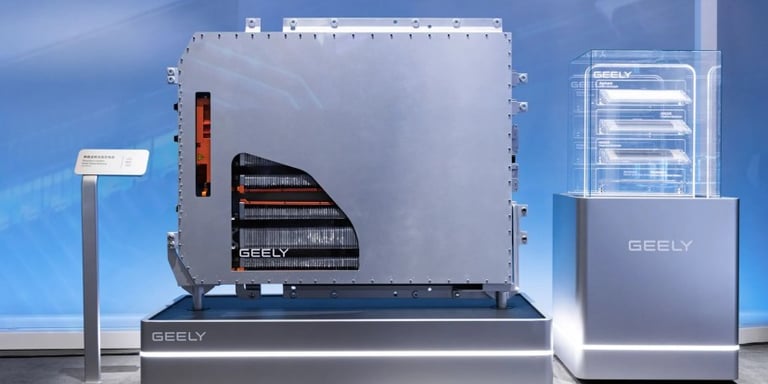

Geely is developing a next-generation solid-state battery claimed to achieve about 500 Wh/kg energy density for EVs, which could roughly double the energy per kilogram over current high-nickel NMC cells and far exceed LFP packs.
Geely has previously announced in-house solid-state pack development and testing on existing EV platforms, with the 500 Wh/kg target representing the next step beyond that program.
If realized, a 500 Wh/kg solid-state cell would enable two possible outcomes: either maintaining current range with roughly half the battery weight, or delivering much larger ranges within the same weight budget, potentially pushing beyond 1,000 km per charge.
Real-world validation of the cells began in 2026, with pilot deployments planned across Geely’s brands (Zeekr, Volvo, Polestar, and others) in 2027, though full production feasibility remains under assessment.
Geely cites battery durability up to 1 million kilometers and notes Dow Chemical’s role in providing a thermally stable solid-state adhesive, with pack adhesion designed to maintain stability from −40 °C to 120 °C.
Dow Chemical is named as a materials partner, providing a solid-state adhesive stable across a wide temperature range, highlighting temperature stability as a key challenge in solid-state tech.
Current benchmarks show NMC lithium-ion cells at roughly 250–300 Wh/kg (cell level) and Geely’s own Golden Brick LFP pack around 128 Wh/kg, underscoring the performance gap between cell and pack.
Geely projects a vehicle range of over 620 miles on a single charge if pack weight remains constant while energy density doubles.
Geely claims battery durability up to 1 million kilometers and notes Dow Chemical’s involvement for thermal stability, with pack adhesion helping maintain stability from −40 °C to 120 °C.
Other major players (CATL, BYD, Toyota) are targeting 2027 for pilot solid-state efforts, suggesting that year marks a common milestone rather than a guaranteed launch window.
If 500 Wh/kg solid-state cells prove scalable and affordable, they could redefine EV range and weight, but substantial technical and economic hurdles remain before mass-market adoption.
Summary based on 2 sources
Get a daily email with more Tech stories
Sources
Electrek • Aug 20, 2026
Geely prepares revolutionary 500 Wh/kg solid-state EV battery that could beat diesel
ArenaEV • Aug 20, 2026
Geely says we will see its 500 Wh/kg solid-state in vehicles next year